As an obsessive naturalist, I find it easy to remember the dates of my first sightings of species. Kingfisher – 18th August 2005. Purple Heron – 17th July 2010. Bottlenose Dolphin – 29th April 2017. These encounters cause such a rush of excitement and satisfaction that the timestamp is burned into our memories forever. But there’s one that exceeds them all: 31st July 2017 – the day I saw my first beaver.
The Eurasian Beaver has been on my nature bucket list for as long as I can remember, having long been thwarted in my attempts to see them. But in July 2017 I found myself staying in Kilmartin, a small village in Argyll and Bute in west Scotland which was within easy reach of Knapdale Forest. Knapdale is home to the first beaver reintroduction project in Scotland. No beavers had been recorded in the country for over 400 years until 2009 when the Scottish Beaver Trial, a partnership of the Scottish Wildlife Trust, The Royal Zoological Society of Scotland and Forestry Commission Scotland, gained permission to release 16 beavers at the site over a five year trial. Following close monitoring the trial was deemed successful and in 2016 the Scottish government re-classified beavers as a native species and formalised their protection. By 2017, plans were being made to release more beavers at the site.
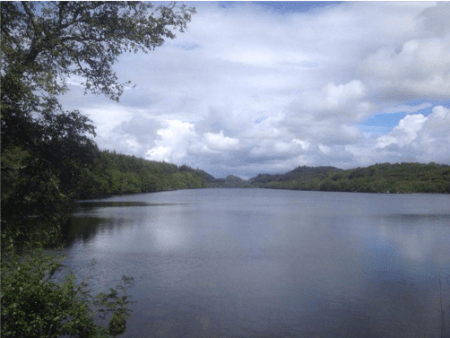
Loch Collie Bharr
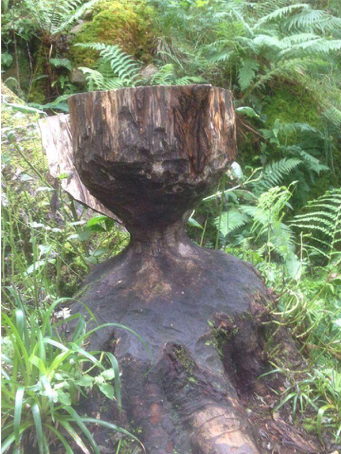
I arrived at Barnluasgan Information Centre on the afternoon of the 31st July with heightened anticipation. It was about a mile walk to Dubh Loch and Loch Collie Bharr, the site of their release, where I was stunned by how plentiful the signs of their activity were. Many of the trees around the edge of the water had been felled and the waterways fashioned into characteristic beaver canals. Further down the loch, the dam was visible – a vast yet architecturally intricate structure. Nearby tree trunks had been whittled down with their exceptionally strong teeth – rather than magnesium beavers have iron in their tooth enamel to strengthen them. It was clear to see that these ecosystem engineers were having a positive impact on this landscape – helping to introduce new wetland habitat and improving riparian woodland, which brings a host of benefits to other species.
It was fantastic to see first-hand the first successful reintroduction of beavers to Scotland. But for an addicted naturalist, it wasn’t enough – I wanted a sighting.
After dark, I returned to the site (with my trusty midge net). For several hours, all was still except for the darting of hundreds of bats overhead. It was an impressively dark night with very little moon and plenty of cloud, but from our position on the pontoon alongside Collie Bharr, there were excellent views of both the dam and the loch.
After two or three hours, I was about to give up for the night when it happened. A slight splash on the edge of Collie Bharr made the breath catch in my throat. And then out of nowhere the unmistakable shape of a beaver glided smoothly past the pontoon. It was perhaps 10 metres away and I could clearly see the large paddle-like tail and hear it slapping the water – it was definitely an adult. I watched it travel around 15 metres as it swam along the loch and then it disappeared into the shadows. I’d like to say I got a photo of the encounter. But when it came to it, I was utterly transfixed – I didn’t want this moment to be remembered through a lens.
Knapdale beaver field signs
It was the most fleeting of encounters but it really struck a chord with me. Here was first-hand evidence of a really positive conservation story – the first ever native mammalian reintroduction to Scotland. It shows what’s possible with dogged perseverance and excellent science. Since my visit, more beavers have been released at Knapdale as part of an ongoing plan to ensure their long-term survival.
If you get the chance to go Knapdale – take it. The visit was a defining moment for me, not just because I saw a beaver, but because those beavers represent a significant step towards the longevity of the Eurasian Beaver in the UK – and that’s fantastic.
The CEO of HS2 heralded it as the “biggest environment project in Britain.” And yet campaigners, environmentalists and major conservation charities are fighting for its cancellation.
So what is going on? Rob Knott discusses the environmental concerns.
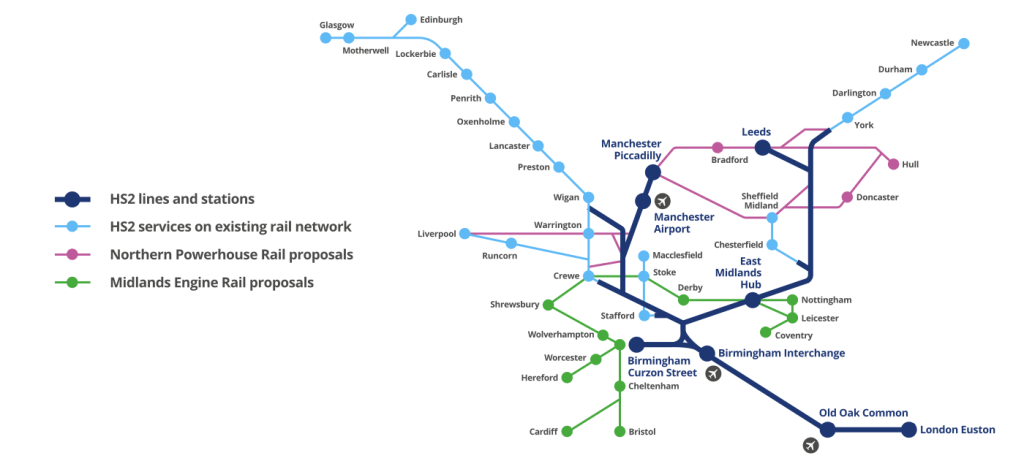
In 2010, High Speed 2 (HS2) was proposed by the British government as a new rail route to our northern towns. With 343 miles of track, 45 of these below ground and 37 on viaducts, it’s one of the most ambitious infrastructure projects ever planned. It’s due to take place in several phases. Phase 1 will link London with Birmingham with phases 2a and 2b later joining up with Manchester and Leeds and connecting with existing northern lines. But the project comes with an extraordinary price tag and timeline – already well over budget, it’s expected that HS2 won’t be completed until 2035 at a cost of over £100 billion. So what are the benefits promised?
HS2 aims to benefit Britain with 3 C’s: capacity, connectivity and carbon. Firstly, the project hopes to increase capacity for commuters by providing an alternative to existing transportation. By providing extra seats across the network, the project predicts it can serve an additional 2 million customers a day, thereby reducing overcrowding and increasing freight space on existing services.
Next up, connectivity. The new transport links will provide faster travel, for example London Euston to Birmingham is estimated at 45 minutes, whilst Euston to Manchester is expected to take 67 minutes. It is hoped that this will open up the north of England for business expansion and more job opportunities. Furthermore, it is also hoped that faster journey times will increase tourism by up to £200 million in areas like the Lake District and Yorkshire Dales. However, this is perhaps a little ambitious considering 83% of visitors to the Lake District currently travel by car anyway.
So that leaves us with the final ‘C’ – carbon. It’s the one that we’ll focus on as it alarms environmentalists the most. HS2 promises to help the UK reach its target of carbon neutrality by 2050 by increasing carbon efficiency for long distance travel and mitigating building work emissions. This sounds promising – but let’s look at how they intend to meet this.
One of the major points is flight. HS2 argues that by connecting 8 major UK cities, people are more likely to make the shift from short-haul flights to train travel. At its basic level, this seems a good idea – it has been calculated that HS2 travel would produce only 8 grams of carbon per person per kilometre compared with 170g by the aeronautical equivalent, thus making HS2 a carbon friendly option.
However, merely stating that people will shift from planes to trains doesn’t mean it is true. HS2’s own predictions show that only 1% of customers on HS2 will have switched from flying by air. By looking at the number of domestic flights, it is clear why. There are currently no direct flights from London to Birmingham and only a handful each day to Manchester. BAA, the company who own Heathrow and support HS2 have at best case predicted only a 22% decline in domestic flights following the completion of the project – suggesting there simply isn’t the demand. What is more, BAA have indicated the reduction in domestic flights would allow them to re-deploy planes to meet the demand for long-haul flights which in the long run would serve to increase carbon emissions. Chris Packham, an ardent campaigner for scrapping HS2, makes the point that creating better connections to airports in Birmingham and Manchester could also facilitate airport expansion in the north and lead to a rise in the number of people using them from which to travel long haul. And so whilst HS2 claims that flight emissions will be reduced, it could in fact be quite the opposite.
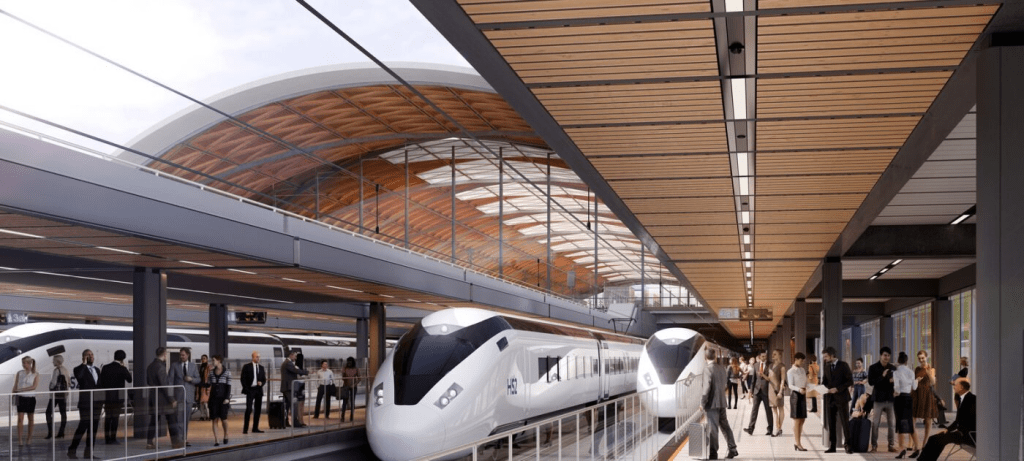
The team behind HS2 also advocate that the new transport network will play a key role in helping the UK to meet its target of zero carbon emissions by 2050. They say that the project design focuses on carbon efficiency including greener trains, bridges and tunnels. The flagship new station for the project, Interchange Station, has been proclaimed as one of the top 1% of all new build designs for its consideration of energy efficiency.
However, try as might, the project simply isn’t doing enough to minimise carbon loss. Stop HS2, the main campaign focus for halting the project sums it up nicely: “trains have to be better than cars and planes.” They argue that the carbon cost of building the train line vastly undercuts any carbon saving. A phenomenal workforce of machinery will indeed be needed to complete the project, not to mention the resources for tunnel boring – this process is expected to require up to 10 million litres of water every day. The huge carbon expenditure of building is backed up by HS2’s own calculations which show that after 120 years, the project will still have seen a net increase in carbon to the atmosphere. This has led to recent change in slant by the government from suggesting the project will reduce net carbon loss to stating that the project will be carbon neutral – hardly an environmental incentive.
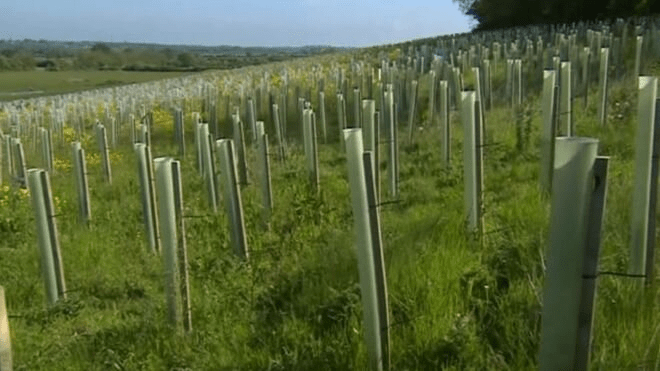
The project has also placed great emphasis on mitigating the harmful effects to wildlife. Since work officially started in 2018, 7 million trees have been planted. However, 1000s of these trees have already died because HS2 didn’t budget money to water these trees and as such they perished in a drought last summer.
Some of the trees which have already died. Source: BBC News
A similar failed mitigation occurred at Doddershall Meadows near Quainton. The scheme promised to create 60 new wildlife areas to offset disturbed habitats, including a new wildlife zone adjacent to Doddershall Meadows, a SSSI grassland site. Unfortunately, contractors laid steel tracks right across the meadow in order to reach the new wildlife site, causing heavy disturbance. Such clumsy failings make mitigation measures futile.
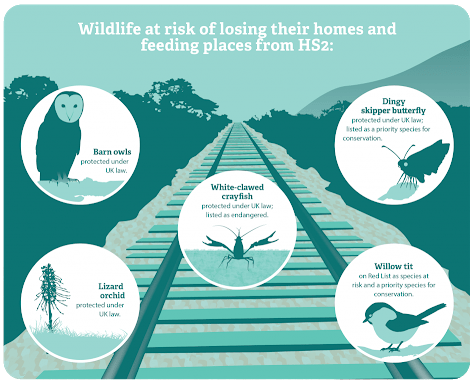
After the then transport secretary Justine Greening made her hilariously incompetent suggestion in 2011 that ancient woodland could simply be moved, HS2 changed tack and promised that 85% of the total area of disturbed ancient woodlands would remain intact following construction. However, this figure neglects to mention the 700 wildlife sites which will be disturbed, including 33 SSSIs. These sites are home to countless rare species, a very short list of which include Dingy Skipper butterflies, Bechstein’s bats, hedgehogs, Barn Owls and Great-crested Newts. A closer look at the HS2 environmental reports reveal that biological impact assessments have neglected to consider building disturbance and sites without formal protection. There are too many examples of species and habitats which will be destroyed by HS2, but the Wildlife Trust provides comprehensive examples of many of these along with their proposal for a Greener Vision for HS2 which hopes to mitigate many of the measures imposed – which has so far largely been ignored.
Some of the species which will be permanently affected by HS2. Source: Stop HS2
It is clear to me that whilst HS2 may provide some benefits to capacity and connectivity, the environmental disadvantages are too great. Clumsy mitigation strategies feel like a box-ticking exercise designed to appease environmentalists whilst the cherry-picking of carbon data presents a wildly inaccurate view of its emissions. The project will destroy our connection with the landscape and disturb many rare species. As such, labelling it as the “greatest environment project in Britain” is simply absurd – imagine how £100 billion could be spent if it were put straight into conservation. The project represents much of what is wrong in this climate emergency – environmental action and protection is at the mercy of the economists. It’s high time that changed.
If you want more information about HS2 then visit the website. If you want to know more about what you can do to help combat HS2 including writing to your MP then Stop HS2 is the place to go. Chris Packham, who is currently protesting HS2 in the Court of Appeal has some great videos too.

 Rob Knott